


Table of Contents
- Why Clear Food Labels Matter at Parties
- Dietary Restriction Food Label Examples
- Party Food Allergen Signs: What to Include
- How to Label Buffet Food Effectively
- Food Allergy Labels for Parties: Best Practices
- Practical Labelling Systems for Your Party
- Common Mistakes to Avoid When Labelling Food
- Frequently Asked Questions
Last Updated: October 10, 2026
Why Clear Food Labels Matter at Parties
How to label food for dietary restrictions at parties starts with understanding why it matters. Your guests need to eat safely and confidently. A clear label takes seconds to read but prevents serious health issues.
When someone has a genuine allergy, cross-contamination or hidden ingredients can trigger a reaction. Even mild dietary preferences deserve respect at your table. The person avoiding gluten or dairy shouldn’t have to ask about every dish. They should be able to scan your buffet and know exactly what’s safe.
The difference between a thoughtful event and a stressful one often comes down to these small details. Proper labelling shows your guests you’ve considered their needs before they arrive.
Start labelling early. Don’t wait until guests are standing at the buffet hungry and confused. Labels prepared in advance look intentional and professional.
Dietary Restriction Food Label Examples
Dietary restriction food label examples help you understand what information matters most. Different restrictions require different label details.
Vegan and Vegetarian Labels
A vegan label needs to be clear and specific. “Vegan” tells the story immediately. But add a detail: “Vegan Pasta Primavera – No animal products, no dairy, no eggs.”
Vegetarian dishes can include dairy or eggs, so be precise. “Vegetarian Risotto – Contains dairy and butter” prevents disappointment. Some guests avoid dairy but eat eggs, or vice versa.
Use consistent wording across all your labels. If you write “Contains dairy” on one dish, write it the same way on every other dish. Consistency makes scanning easier.
Gluten-Free and Coeliac-Safe Labels
Gluten-free labelling requires extra care. “Gluten-Free” is the baseline. Add where it matters: “Gluten-Free Bread – Prepared in dedicated space, no cross-contamination.”
For coeliac guests, cross-contamination is serious (Managing Cross Contact at home). If your gluten-free item was prepared on the same bench as bread, mention it. “Gluten-Free Pasta Salad – Prepared on shared bench with gluten items” is honest and helpful.
When you’re unsure, say so. “Gluten-Free Status Unknown” is better than guessing. Your guest can ask you directly rather than risk it.
Dairy-Free and Lactose-Free Labels
Dairy-free and lactose-free are different. Lactose-free means the lactose has been removed but dairy protein might remain. Dairy-free means no milk products at all.
Label each clearly: “Dairy-Free Chocolate Mousse” or “Lactose-Free Cream.” If a dish uses plant-based milk, say it: “Vegan Cream – Made with oat milk.”
Some guests avoid dairy for allergies, others for ethics, others for digestion. Your label respects their choice by being specific.
Party Food Allergen Signs: What to Include
Party food allergen signs protect your guests and show professionalism. Include the allergen name and any relevant details.
Major Allergens to Always Label
Australia’s standard allergens are: peanuts, tree nuts, sesame, milk, eggs, fish, shellfish, soy, wheat, and sulphites. If your dish contains any of these, label it.
“Contains Nuts” is clear. “Contains Shellfish” is specific. Don’t assume guests know what’s in your dish. Write it down.
Some dishes contain hidden allergens. Pesto has pine nuts. Soy sauce has soy. Caesar dressing has anchovies. Label these even if they’re not the main ingredient.
Never assume a guest will ask. Many people with allergies have learned to be quiet about it. Clear labels remove the burden of asking and reduce anxiety about hidden ingredients.
Formatting Allergen Information for Clarity
Use a consistent format for all allergen labels. Choose one style and stick with it. Options include:
- Bold text: Contains Nuts
- Uppercase: CONTAINS SHELLFISH
- Colour coding: Red background for allergens
- Icon system: A nut symbol for nut allergies
Whatever format you choose, make it readable from arm’s length. A guest scanning your buffet shouldn’t need to lean in to read labels.
How to Label Buffet Food Effectively
How to label buffet food effectively depends on placement and design. Both matter equally.
Placement and Visibility
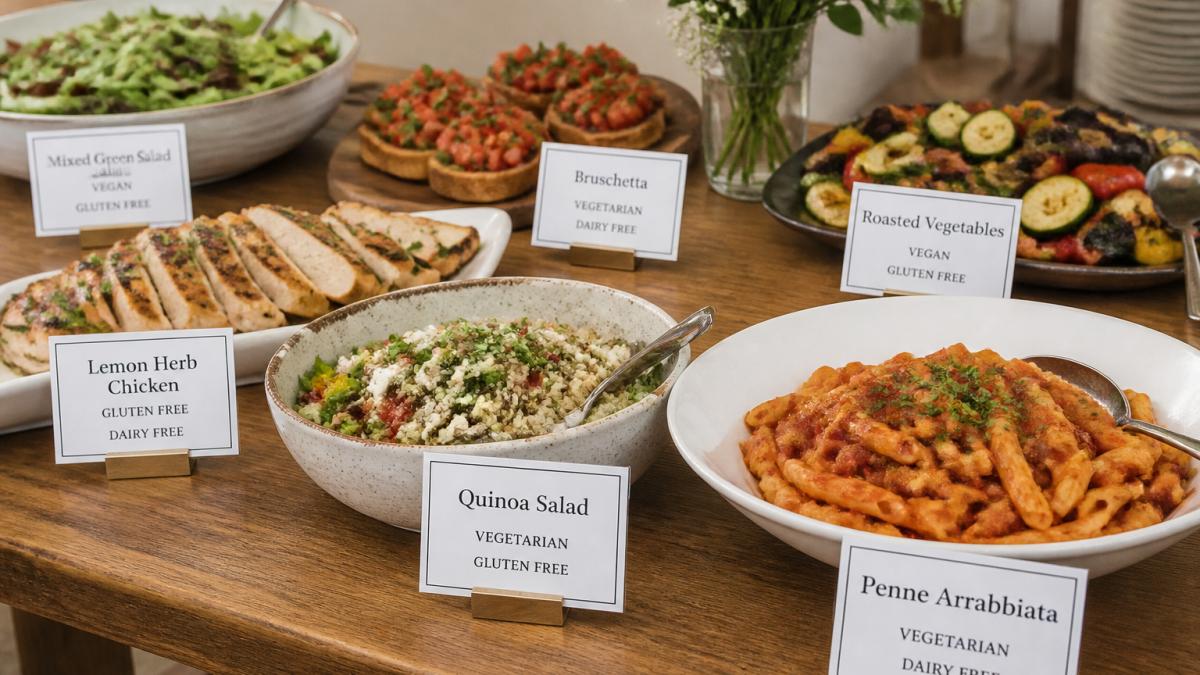
Place your label directly in front of each dish, not behind it or to the side. A guest approaching the buffet should see the label before they serve themselves.
Use small stands or tent cards. Prop them at an angle so they’re easy to read. If you’re using adhesive labels on serving dishes, place them on the front face, not the rim.
Keep labels at eye level. Don’t hide them under the dish or tucked behind a serving spoon. The label should be the first thing a guest notices about each food item.
Label Design and Readability
Use large, dark text on light backgrounds. Black text on white card is the clearest option. Avoid light grey or pale colours that fade into the background.
Font size matters. Minimum 14-point font for arm’s-length reading. If your handwriting is small, print labels instead.
Keep text simple. One line per label if possible: “Vegan Pasta” or “Contains Nuts.” If you need multiple lines, use short phrases, not sentences.
Food Allergy Labels for Parties: Best Practices
Food allergy labels for parties need to go beyond just naming the allergen. Your guests need to trust your information.
Communicating Cross-Contamination Risks
If a dish might have been exposed to an allergen during preparation, say so. “Prepared on a shared bench with nuts” is honest and helpful.
If you prepared it in a dedicated, clean space, say that too: “Prepared in a nut-free zone.” This reassures guests with severe allergies.
Some hosts use a simple system: “Safe for strict allergies” versus “Possible cross-contamination.” Choose language that works for your kitchen.
What to Do When You’re Unsure About Ingredients
If you’re not certain about an ingredient, label it as uncertain. “Gluten Status Unknown – Please Ask” prevents a guest from taking a risk.
Contact the manufacturer if you have packaged items. Most labels list allergens clearly. If you’re serving store-bought food, read the package.
For homemade dishes, write down every ingredient as you cook. Then review it against the allergen list. This takes five minutes and prevents mistakes.
Uncertain labels are better than wrong ones. A guest would rather ask you than risk an allergic reaction.
Practical Labelling Systems for Your Party
Practical labelling systems make the job easier and faster. Choose one that fits your style.
Colour-Coded Labels and Icons
Colour coding works well for large parties. Assign one colour to each restriction type:
- Green for vegan
- Yellow for vegetarian
- Red for allergen warnings
- Blue for gluten-free
Use small coloured dots or full-colour cards. Guests learn the system in seconds.
Icons work too. A leaf for vegan. A wheat stalk crossed out for gluten-free. A shellfish symbol for shellfish allergies. Icons work across language barriers.
Combine text and colour. “Vegan” in green text helps colour-blind guests. Text plus colour plus icon is the most accessible approach.
Digital and Physical Label Options
Printed labels look professional and are easy to prepare ahead. Type them in a large font, print them, and tape them to card stock.
Handwritten labels are personal and charming if your handwriting is neat. Use a thick marker so text is readable.
For tech-savvy events, consider a small digital display near each dish. A tablet showing allergen information works at corporate events in Sydney.
For most home parties, printed labels on card stock are ideal. They’re affordable, professional, and reliable.
Common Mistakes to Avoid When Labelling Food
Common mistakes undermine even the best intentions. Watch for these.
Don’t use tiny text. Labels guests can’t read from a distance are worse than no labels. Err on the side of oversized.
Don’t hide allergen warnings inside longer descriptions. “Creamy pasta with garlic, herbs, and contains shellfish” buries the critical information. Put allergens first or in bold.
Don’t assume dietary restrictions are obvious. A cream sauce might be dairy-free if made with plant milk. A burger might be vegan if made with a plant-based patty. Label the actual contents, not what the dish looks like.
Don’t forget about sauces and dressings. The main dish might be vegan, but the sauce could contain dairy. Label them separately or note the sauce on the main label.
Don’t label only some dishes. If three dishes are vegan and three aren’t, label all six. Consistency prevents confusion.
Frequently Asked Questions
What information should I include on a party food label for dietary restrictions?
Include the dish name, main ingredients (especially common allergens like nuts, dairy, gluten, shellfish), and any dietary flags such as vegan, vegetarian, gluten-free, or dairy-free. If cross-contamination is possible, note that too. Keep labels simple and readable from a distance so guests can quickly identify safe options without holding the label close to their face.
How do I label food for common allergies at a party?
List major allergens prominently: peanuts, tree nuts, shellfish, fish, eggs, dairy, soy, sesame, and gluten. Use bold text or a contrasting colour for allergen warnings. If a dish contains multiple allergens, list them clearly. For shared serving utensils, note whether cross-contamination is possible so guests with severe allergies can make informed choices.
What should I write if I’m unsure whether a dish is safe for someone with dietary restrictions?
Write ‘May contain’ or ‘Prepared in a facility that processes’ followed by the allergen or dietary concern. For example, ‘May contain nuts’ or ‘Prepared in a kitchen with gluten.’ This honest labelling protects guests with allergies and prevents accidental exposure. When in doubt, err on the side of caution rather than guessing.
How can I show whether a dish is vegetarian, vegan, or gluten-free on a buffet label?
Use clear, concise labels with dietary symbols or badges. Write ‘Vegetarian,’ ‘Vegan,’ or ‘Gluten-Free’ directly on the label in a prominent position. Consider using colour-coded stickers or icons if you have many dishes. Ensure labels are visible and easy to read so guests don’t have to ask you about every option.
Hosting a dinner party in Sydney means managing different dietary needs. When you label food clearly, everyone eats with confidence. At The Italian Table specializes in crafting customised dining experiences that accommodate all dietary requirements, from vegan and gluten-free to allergen-conscious menus. Our team handles the details so you can focus on your guests. Enquire now to learn how we can make your next event both memorable and inclusive.