


Table of Contents
- Why No-Cook Appetisers Work for a Crowd
- Dips and Spreads That Scale Without Stress
- Skewers, Bites and Handheld No-Cook Appetisers for a Crowd
- Appetiser Quantities Per Person: How Much to Make
- Make-Ahead Appetisers: What to Prep the Day Before
- Cheap Appetisers for a Crowd Without Looking Cheap
- Platters and Presentation: Making a No-Cook Spread Look Impressive
- When to Bring in a Private Chef Instead
- Frequently Asked Questions
Last Updated: October 8, 2026
Why No-Cook Appetisers Work for a Crowd
Easy no cook appetizers for large groups solve a specific problem: you want to feed thirty people well without spending the entire party in the kitchen. Cold dishes, assembled platters and dips can all be prepared ahead, which means you are present at your own event instead of chained to the stove. At At The Italian Table, we have cooked for Sydney homes and workplaces for years, and the hosts who enjoy their own parties are the ones who plan the food around what can be done in advance.
The maths is simple. A hot canapé demands last-minute cooking, plating and timing. A no-cook spread asks only for assembly, and assembly can happen the day before. The trade-off is that cold food has nowhere to hide: if the produce is tired or the seasoning is flat, guests notice immediately.
The single biggest upgrade to any no-cook spread is salt and acid applied at the last minute. Dress a platter too early and the vegetables weep; dress it just before guests arrive and everything tastes sharper.
Dips and Spreads That Scale Without Stress
Dips are the most forgiving thing you can serve a crowd, because they multiply without changing technique. Double the recipe, use a bigger bowl, done. Whipped feta with olive oil and lemon, hummus with smoked paprika, and a good basil pesto loosen with a spoonful of yoghurt all hold for hours at room temperature.
Two rules keep a dip table from looking tired. First, serve no more than three dips, each in a bowl that is clearly different in colour or shape. Second, give every dip its own garnish so guests can tell them apart at a glance. A swirl of oil, a scatter of toasted seeds, a few torn basil leaves.
For quantities, plan on roughly 30 to 40 grams of dip per guest when dips are one part of a wider spread. That is about one generous tablespoon each, which sounds modest until you remember the skewers and platters alongside it.
Skewers, Bites and Handheld No-Cook Appetisers for a Crowd
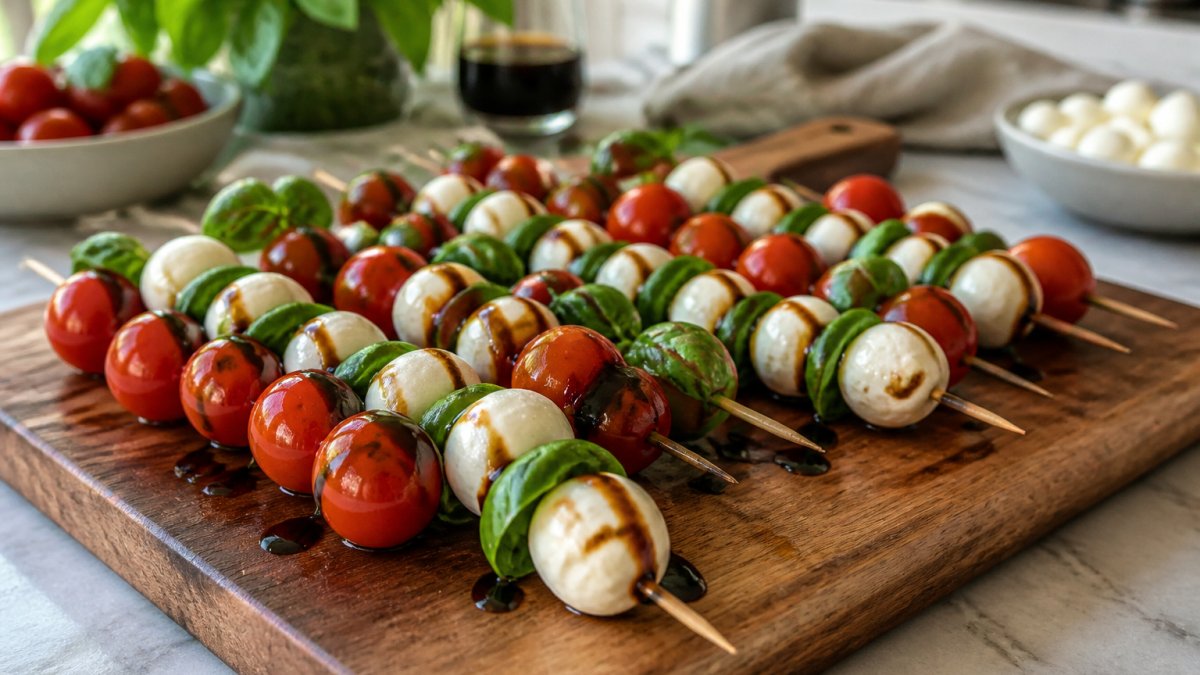
Handheld bites do the heavy lifting at a large gathering because guests can eat them standing up, one hand free for a drink. Caprese skewers, melon wrapped in prosciutto, cherry tomato and bocconcini on a toothpick, and cucumber rounds topped with smoked salmon all assemble in minutes and travel well on a tray.
The practical constraint is the toothpick. Anything that falls apart when lifted is a bad appetiser, no matter how good it tastes. Test one before you commit to a hundred.
- Caprese skewers: bocconcini, cherry tomato and basil, finished with balsamic glaze
- Prosciutto and melon: wrap at the last minute so the melon stays firm
- Tomato and feta bites: marinate overnight, drain before serving
- Cucumber and salmon rounds: assemble on the tray, never in advance
Appetiser Quantities Per Person: How Much to Make
Appetiser quantities per person depend on timing and whether a meal follows. For a two-hour stand-up event before dinner, plan six to eight bites per guest. For a longer cocktail-style gathering with no meal, plan ten to twelve. If the appetisers are the meal, go higher again.
| Event Type | Bites Per Person | Dip Per Person | Skewers Per Person |
|---|---|---|---|
| Pre-dinner drinks, 1-2 hours | 5-6 | 30g | 2-3 |
| Cocktail party, 3 hours, no meal | 10-12 | 50g | 4-5 |
| Appetisers as the main food | 14-16 | 70g | 6-8 |
These figures assume a mixed spread of dips, platters and handheld bites. If you are serving only one style, add two to three bites per person to compensate. Always make one tray more than you think you need; running out is the only failure guests remember.
Make-Ahead Appetisers: What to Prep the Day Before
Make-ahead appetisers are the reason a no-cook spread works for large groups at all. Almost everything can be done the day before, leaving only assembly and dressing for the day itself.
- Marinate tomato and feta bites overnight in olive oil, oregano and chilli
- Roast and cool any capsicum or eggplant for platters
- Make dips and store in airtight containers, garnishing only at serving
- Wash, dry and cut all vegetables; store in damp tea towels
- Skewer anything that holds, such as bocconcini and olives
- Chill drinks, count glassware, and set out serving boards the night before
What you should not do ahead: dress salads, cut avocado, or assemble anything involving bread or crisp crackers. Those three tasks take ten minutes on the day and lose hours of quality if rushed the night before.
Cheap Appetisers for a Crowd Without Looking Cheap
Cheap appetisers for a crowd fail for one reason: they look like an afterthought. The fix is not spending more, it is spending well. Eggs, legumes, good bread and seasonal vegetables cost very little and, presented properly, read as generous rather than budget.
A devilled egg, halved and piped with a little paprika, costs cents and looks deliberate. A white bean dip with rosemary and olive oil does the same job as a far more expensive cheese board. Stuffed celery, marinated olives, and a bowl of good bread with quality olive oil round out a table for very little.
The one place to spend is olive oil and salt. Cheap oil and table salt undo everything else on the table, and the upgrade costs almost nothing across a whole spread.
Do not stretch a spread by cutting the protein and doubling the crackers. Guests read that instantly as a thin table. Use cheaper proteins, such as legumes and eggs, rather than less of the good ones.
Platters and Presentation: Making a No-Cook Spread Look Impressive
Presentation is what separates a spread that looks catered from one that looks assembled in a hurry, and it costs nothing but attention. Use boards and bowls of different heights, group food in odd numbers, and leave space between items. A crowded platter reads as cheap; a platter with air around each element reads as considered.
Work in threes. Three dips, three platters, three heights. Vary the colours so no two adjacent items are the same shade, and put the brightest dish where the light falls. For a Sydney summer gathering, keep everything on ice or in the shade and rotate trays from the fridge rather than putting everything out at once.
When to Bring in a Private Chef Instead
There is a point where no-cook stops being the easy option. Thirty guests, a milestone birthday, and a kitchen the size of a wardrobe is that point. If you are hosting in Sydney and want restaurant-quality food without the assembly line, a private chef removes the whole problem.
At At The Italian Table, we bring over 25 years of culinary experience into your home or workplace, cooking fresh on the day rather than reheating anything prepared elsewhere. We handle customised menus for corporate events, weddings and intimate house parties, and we work in home kitchens of every size. If you are weighing up a no-cook spread against a catered one, our team can talk you through what suits your guest numbers and your space.
Frequently Asked Questions
What are easy no-cook appetisers for a large group?
The easiest options are dips with vegetable crudités, caprese or antipasto skewers, charcuterie and cheese platters, and stuffed vegetable bites. They need no heat, scale in minutes, and hold up on a table for hours. For a crowd, build two or three dips, one or two skewer types, and a large platter so guests can serve themselves without queuing.
How many appetisers should I serve per person?
For a two-hour event, allow four to six bites per person; for a longer gathering or one replacing a meal, plan eight to ten. Appetiser quantities per person also depend on what else is served. If a main follows, four bites each is plenty. If it is drinks only, aim higher. Always round up rather than down when guests are hungry.
What are inexpensive appetisers to make for a crowd?
Cheap appetisers for a crowd include hummus with pita triangles, marinated olives, tomato and feta bites, and vegetable sticks with a yoghurt dip. Buying tinned chickpeas, seasonal vegetables, and block cheese rather than pre-cut saves money. One large platter of mixed items costs less per head than several small, separate dishes.
Which no-cook appetisers can I prepare ahead of time?
Make-ahead appetisers include dips, marinated olives, tomato and feta bites, and skewers. Prepare dips a day ahead and refrigerate in airtight containers. Assemble skewers the night before, cover, and chill. Keep wet ingredients separate from crisp ones until serving so textures hold. Anything with fresh herbs is best finished just before guests arrive.
How do I keep cold appetisers fresh at a party?
Serve cold items in shallow bowls set over a larger bowl of ice, and keep dips out for no more than two hours. Refrigerate backups and swap platters rather than topping up the same one. On a warm day, place platters in the shade and avoid direct sun. For longer events, split each dish into two batches and serve the second later.
Hosting a large gathering should not mean missing your own party. If the guest list has outgrown the fridge, At The Italian Table can take the food off your hands entirely, with freshly cooked, customised menus for homes and workplaces across Sydney. Our private chef service covers everything from board lunches to milestone celebrations, and we cook on site so nothing arrives reheated. Enquire now to discuss your event.